
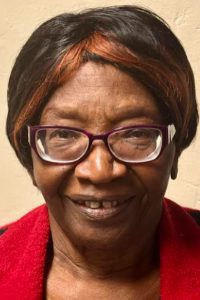
Heritage stories
Gurnenla Beckett
Nurse, NHS · arrived from the Caribbean, 1961
I was nineteen years old when I left Manchester — not the one here, the one back home, a little parish in Jamaica where everybody knew my mother and my mother knew everybody. I had never been further than Kingston. And then one morning I was standing on a dock with a cardboard suitcase, a winter coat my aunt swore I would need, and a letter from a hospital in England saying they would have me.
They wanted nurses. That is the part people forget now. We did not arrive uninvited. There were posters, there were advertisements in our newspapers, there were people from the Ministry coming to the islands to tell us that the Mother Country needed hands, and that nursing was a good and respectable profession for a young woman. My father read that letter out loud at the table three times. The third time his voice went quiet. I think he understood before I did that I was not coming back the same.
They needed nurses, and we came. We did not arrive uninvited.
The ship took the best part of three weeks. I was sick for the first few days and then I was fine, and I spent the rest of the crossing on deck with other girls just like me — girls who could cook and pray and laugh and who were all, every one of us, terrified underneath. We made each other brave. By the time we saw the grey line of England coming up out of the sea, we had decided amongst ourselves that we were going to be the finest nurses that country had ever seen.
Then the cold hit me. I want you to understand — I had been told about the cold, my aunt had packed me a coat for the cold, and still nothing prepared me. It got into my bones in a way I did not have words for. The first winter I cried from it more than once, privately, where nobody could see, because I was not going to give anybody the satisfaction. The sky was the colour of dishwater for months. I used to dream in colour — the green of home, the blue of the water — and wake up to grey.
I started my training within the week. And here is something I learned quickly: the country that had written to ask for me had not entirely told its own people I was coming. There was a system. Girls like me, no matter how clever, were pushed toward the enrolled nurse route rather than the registered one — the shorter qualification, the one that kept you at the bedside and away from the senior posts. Nobody said why out loud. They did not have to. You learned to read what was not said.
Nobody said why out loud. They did not have to. You learned to read what was not said.
I will not pretend it did not hurt. It hurt. I had topped my class back home. But I made a decision early, and I have never regretted it: I was not going to let anybody’s small idea of me become my idea of myself. If they wanted to keep me at the bedside, then I would be the best thing that ever happened to that bedside. I would know my patients better than anyone. I would be the nurse people asked for by name.
And that is exactly what happened, though it took years.
The matron in those early days was a fearsome woman — strict, sharp, not a hair out of place, and not one ounce of warmth that you could see. I was frightened of her for a long time. But she was fair, and in that hospital fairness was worth more than warmth. She watched me. She watched how I was with the frightened ones, the old men who had been through one war or two and did not want a fuss, the children who would not settle for anyone else. One day, years in, she stopped me in the corridor and said only, “You have good hands, Nurse Williams.” Then she walked on. I stood there in that corridor and I could have wept. From her, that was a medal.
The patients were their own education. Some of them had never in their lives been cared for by somebody who looked like me, and you could watch them deciding, in those first few seconds, what kind of person they were going to be about it. Most of them — and I want this remembered — most of them were kind. There was a Mr. Hargreaves, an old miner, who would not be washed or turned by anyone but me, and who called me “lass” right up until the day he died holding my hand. There were others who were not kind, who said things, who asked for a different nurse. I learned to let it run off me like rain off a window. I had not crossed an ocean to be made small by a frightened old man in a bed.
I had not crossed an ocean to be made small.
There was a life happening alongside the work, of course. There always is. I met my husband at a church social in 1964 — he was from Barbados, he could dance, and he made me laugh on a day I badly needed to. We married, we saved, we bought a little house with a garden barely big enough to turn around in, and we raised three children in it. My daughter is a doctor now.
A doctor — in the same health service that decided her mother was only fit to be enrolled. I think about that more than she knows.
The decades went the way decades do — fast at the end. The uniforms changed, the equipment changed, the matron gave way to managers and paperwork and budgets. New young nurses came onto the ward who had not been born when I started, and some of them came from my part of the world, and I made sure — I made sure — that nobody pushed them quietly toward the smaller door the way they had pushed me. I told them what I wished somebody had told me: know your worth before this place tries to set it for you.
Know your worth before this place tries to set it for you.
I gave that hospital forty years. Forty years of early starts in the dark, of double shifts, of Christmases on the ward while my own children waited at home, of holding hands that nobody else would hold. When I retired they gave me a card and a clock and a cake in the staff room, and the young ones clapped, and I went home and sat in my barely-big-enough garden in the English summer light and thought: I did that. Whatever else, I did that.
People ask me sometimes if I regret coming. As if it were one decision, made once, on a dock, by a girl who did not know the cold. It was not one decision. It was thousands of them, made every single day for forty years — the decision to stay, to be kind, to be good at the work, to not let the country’s smallest opinion of me win. And I would make every one of them again.
The thing about nursing is that it stays with people. I still meet them — in the supermarket, at church, the grown children of patients I cared for half a century ago. “You looked after my mother,” they say. “She never forgot you.” That is the whole of it, really.
We were not just doing a job. We were building something, the lot of us, with our cold hands and our homesickness and our refusal to be made small — and it is still standing today.
I helped build that. Remember that we built that.