
Heritage stories
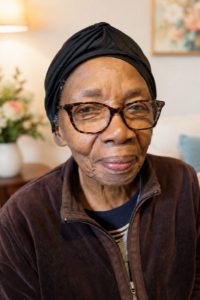
Gloridene Gordon
Nurse, NHS · arrived from the Caribbean, 1961
Would you like this read to you? Just press play below.
Gloridene Gordon was born on 6 July 1940 in Saint James Parish, Barbados. She grew up in a coastal area not far from the sea, where she could see fishing boats returning with their catch. Life was simple and close to nature, and she recalled a happy childhood marked by the staple food of flying fish bought fresh from the boats. Her family faced hardship when her father died when she was twelve, leaving her mother and siblings to manage. Her parents had worked as manual labourers cutting sugar cane, a physically demanding occupation that reflected the limited economic opportunities on the island.
At the age of 20, Gloridene left Barbados and arrived in England on 5 September 1960. Conditions in Barbados were difficult, with few prospects for young people and girls being at risk of becoming pregnant early. Her mother, a principled woman, was determined to secure a better future for her daughter and arranged for her to travel by aeroplane rather than by ship, having heard stories of young women facing danger during long sea voyages. The one-way ticket cost £85, a significant sum that her mother managed to raise. Gloridene arrived in London with only £10 in her pocket, intended to cover two weeks’ rent, bus fares, and food. Her mother’s clear instruction was to find work as soon as possible.
Gloridene’s first job was washing dishes in a hospital kitchen in London, followed by work in a Co-op café, again in the kitchen washing up and serving food. She found these roles unsatisfying and soon sought better opportunities. She prepared multiple job applications and sent them to hospitals across the country, adapting them for roles in mental health, children’s nursing, or adult nursing without knowing the locations of many of the hospitals. One response came from an Irish matron who offered her a position without an interview, instructing her to “come, bring your luggage and come.” The matron even arranged for someone to meet her at the train station. Gloridene began work at Cross Houses Hospital, a small facility five miles outside Shrewsbury.
At Cross Houses, Gloridene started as a student pupil nurse, a role that led to her qualifying as a State Enrolled Nurse (SEN). She did not pursue State Registered Nurse (SRN) training, feeling the academic requirements were beyond her reach at the time, but she undertook additional certificates, including one for working with babies. Her early duties were on the bottom rung, primarily in the sluice room washing bedpans and performing other dirty tasks by hand. The nurses’ home provided accommodation, with rent deducted from her low wages. Pay increased in October after her arrival in March, and she began sending money home to repay the £85 loan for her ticket. She formed good relations with the mostly Black nursing team from the Caribbean and Africa, with a few White nurses from Wales. The matron was protective, issuing passes for evening outings and enforcing curfews.
Gloridene’s faith as a Seventh-day Adventist shaped her approach to work. In London she had refused Saturday shifts in the kitchen due to her beliefs and sought out a Seventh-day Adventist church upon moving to Shrewsbury. She enjoyed caring for people and continued this instinct beyond her paid role, acting as a first aider at church and assisting those in need, such as helping a man with an incorrectly fitted blood pressure cuff or responding to emergencies during services.
Gloridene worked in various NHS settings, including Burton Road Hospital (now closed), the women’s hospital near the eye infirmary, and three years in theatre. She found theatre intense but enjoyable and appreciated the eye infirmary for its proximity and less physically demanding nature. She faced challenges including racist remarks from some patients (“Don’t touch me with your Black hands. Go back to where you came from”) and heavy workloads, particularly the sluice room duties before modern bedpan washers and disposable liners were introduced. She also suffered a hiatus hernia, likely from repeated heavy lifting, which prompted her to seek less strenuous neonatal work.
Gloridene married and raised two children while working night shifts to align with her husband’s bus-driving schedule. She lived on Owen Road for over 40 years, eventually settling into a stable home life in Wolverhampton. She missed Barbados’ warmth, people, food, and environment but built a long-term life in England, returning to Barbados on holiday. At 96 years old, she remained proud of her journey from Barbados to the NHS, viewing it as a path of responsibility, opportunity, and purpose secured through her mother’s determination and her own hard work. Her experience reflects the contribution of many Caribbean women who entered the health service in the post-Windrush era, enduring hardship and prejudice while providing essential care and support within Britain’s evolving National Health Service.